Lore · Celtic Myth and Legend
Samhain and the Holy Island of the Druids
Long before Halloween, Anglesey was the holiest ground in Celtic Britain: an island of sacred groves, where the Druids prized the oak above every other tree and mistletoe above every other plant. What do we really know about them, and about the night the year turned?
“Be warned and commaunded ye who so trespasseth here! Hither lieth a gate of Samhain, to the otherworlde…”
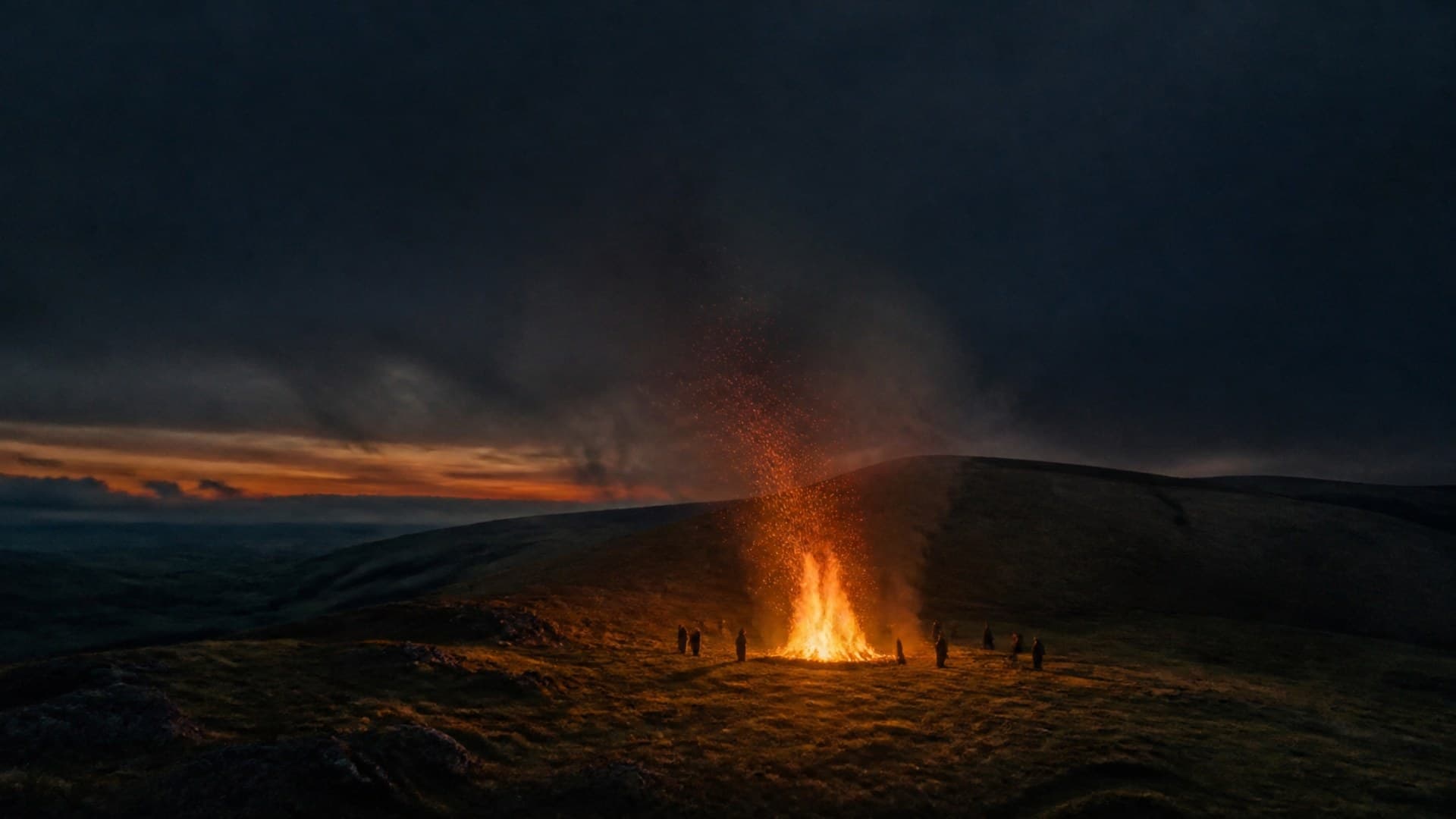
There is a night at the turning of the year when, so our ancestors believed, the door between this world and the next is left ajar. The Irish called it Samhain. The Welsh called it Nos Calan Gaeaf: the eve of the first day of winter. Most of us now call it Halloween.
But if you want to find where the old religion of these islands was at its strongest, don't look to the bonfires of Ireland. Look to a low green island off the north-west corner of Wales. The Romans called it Mona, and the name has never gone away: in Welsh the island is still Ynys Môn, the island of Môn. In English we call it Anglesey. And for a time it was the holiest ground in the Celtic world.
The island Rome feared
Writing in the 50s BC, Julius Caesar described the Druids of Gaul at length: priests, judges and teachers, who trained for up to twenty years and carried everything they knew in their heads. Then he added something remarkable. The whole system, he said, was thought to have begun in Britain, and anyone in Gaul who wanted to learn it properly crossed the sea to study here.
A century later, Britain's own Druid heartland had a name. When the Roman governor Suetonius Paulinus marched on Mona in AD 61, Tacitus tells us the island had a powerful population and was a refuge for everyone who had fought Rome and lost. On its shore the Druids stood with their hands raised to heaven, calling down curses on the invaders. (That extraordinary day has a Lore article of its own: The Last Stand of the Druids.)
What happened next tells you how Rome saw the place. Paulinus didn't simply win a battle. He went after the island's religion. In the words of the old Church and Brodribb translation, the islanders' "groves, devoted to inhuman superstitions, were destroyed".
You don't send an army to fell trees unless the trees matter. Rome understood that Mona's power lay in its sacred places, and it set out to cut them down.
The oak-knowers
So what grew in those groves? Tacitus doesn't say. But another Roman writer, Pliny the Elder, gives us the clearest picture we have of what a Druid held holy, and it was the oak.
The Druids … held nothing more sacred than the mistletoe and the tree that bears it, supposing always that tree to be the robur.
The robur is the oak. According to Pliny the Druids planted whole groves of it and performed none of their rites without oak branches. He even thought their name came from the Greek word for oak, drus.
Modern scholars are more cautious. The word probably goes back to an old Celtic compound, dru-wid, and the wid part means "to know", the same root that gives us "wit" and "wisdom". Whether dru means "oak" or simply "very" is still argued over, so a Druid was either an "oak-knower" or a "very wise one". Perhaps, to the people who used the word, there was no great difference. In modern Welsh a Druid is a derwydd, and an oak is a derwen.
Mistletoe and the golden sickle
If the oak was holy, the mistletoe that grew on it was holier still. Pliny describes the ceremony in some detail, and it is the source of almost every picture of a Druid you have ever seen.
The mistletoe was gathered on the sixth day of the moon, the day that began the Druids' months and years. A banquet was prepared beneath the tree, and two white bulls were led there, their horns bound for the first time. A priest dressed in white climbed the oak and cut the mistletoe with a golden sickle, and the others caught it in a white cloak so that it never touched the ground. Then the bulls were sacrificed, with prayers that the gift would bring good fortune. Mistletoe, they believed, would make barren animals fertile and cure any poison.
There is a catch, and it's an important one. Pliny was writing about the Druids of Gaul, not of Britain, and his is the only account of the ceremony we have. No ancient writer describes it on Anglesey. But if Caesar was right, and the Druids of Gaul learned their religion from teachers on this side of the Channel, it would be surprising if the oak mattered any less here.
Why the mistletoe mattered
Why mistletoe, of all things? Pliny gives part of the answer himself: it is "but rarely found upon the robur". Mistletoe is common enough on apple trees, but on an oak it is a genuine rarity. A survey published in 2019 found just thirteen mistletoe-bearing oaks in the whole of Britain, most of them in and around Herefordshire.
To the Druids, Pliny says, anything growing on an oak had been sent from heaven, and mistletoe on an oak was a sign that the gods themselves had chosen that tree. Find one and you had found a holy place.
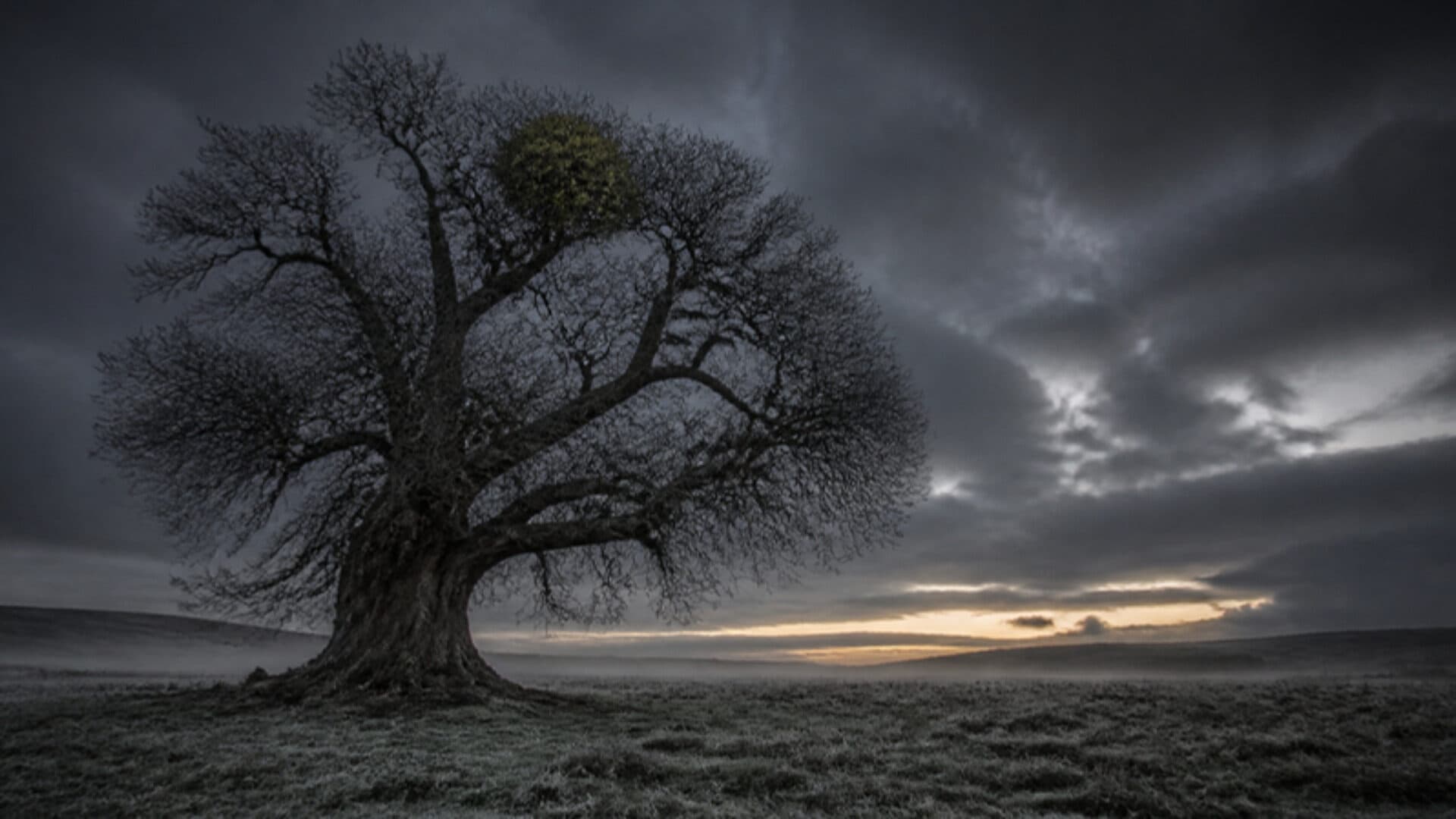
It isn't hard to see the appeal. Mistletoe has no roots in the earth. It hangs between the ground and the sky, and in the dead of winter, when the oak is bare, it stays green and bears its white berries. A plant that refuses to die when everything around it does: you can see why people who believed the soul passed on after death might treat it with awe. The Welsh name, uchelwydd, means something like "the high trees".
A plant that refuses to die when everything around it does: you can see why the Druids might treat it with awe.
Keepers of the turning year
Which brings us back to Samhain. Nothing in the ancient sources ties the golden sickle to any particular festival, and you should be wary of anyone who claims the Druids cut mistletoe at Halloween. But the Druids were the keepers of time. Pliny's ceremony was fixed by the moon, and Caesar says the Gauls counted time by nights rather than days: for them the day began in darkness. Seen that way, Halloween isn't the night before the festival at all. It is the festival.
A bronze calendar found near Coligny in France, made in Gaul under Roman rule, names a month called Samonios, and many scholars see Samhain there. It may well have been reckoned by Druids, or by people trained in their learning, though nobody can be sure.
On Anglesey, as across Wales, the night survived the Druids by nearly two thousand years. Nos Calan Gaeaf was an ysbrydnos, a "spirit night". Families built bonfires on the hills and each person threw a marked white stone into the flames; if your stone had vanished by morning, you would not live to see another winter. As the fire burned low the cry went up and everyone ran for home, because the Hwch Ddu Gwta, the tailless black sow, would take whoever came last. Folklorists recorded that custom right across Wales, but it seems to have been strongest in the north.
What the island remembers
The groves are long gone. Paulinus saw to that, and centuries of farming finished the job: Anglesey has been some of the richest farmland in Wales since at least the Middle Ages, when Gerald of Wales recorded an old proverb in the 1190s calling it Môn, mam Cymru, "Anglesey, mother of Wales", because its grain could feed the whole country.
But the island hasn't quite let go. In 1942, workmen digging peat at Llyn Cerrig Bach found more than 150 offerings that had been thrown into the lake over several centuries: weapons, chariot fittings, cauldrons and a slave chain. And every year, as the light fails at the end of October, the old night comes round again.
Perhaps we haven't come as far as we like to think.
Sources and further reading
- The Natural History, Book XVI, chapter 95, Pliny the Elder, trans. John Bostock and H. T. Riley, 1855
- The Annals, Book XIV, 29–30, Tacitus, trans. A. J. Church and W. J. Brodribb, 1876
- The Gallic War, Book VI, 13–18, Julius Caesar
- Oaks (Quercus spp.) parasitised by mistletoe Viscum album (Santalaceae) in Britain, John Box, British & Irish Botany 1(1), 2019
- Mona Antiqua Restaurata, Henry Rowlands, Dublin, 1723
- The Description of Wales, Book I, chapter 6, Gerald of Wales, c. 1194
- The Coligny Calendar, Gaulish bronze calendar, found near Coligny, France, in 1897; now in the Gallo-Roman Museum, Lyon
- Calan Gaeaf, Wikipedia
- Llyn Cerrig Bach, Amgueddfa Cymru – Museum Wales